


A prospective student submits a form, asks a question, registers for an event, or requests a conversation about a program. That inquiry is valuable, but it is only the beginning of the recruitment process. The outcome depends on whether your institution captures the right information, assigns clear ownership, responds meaningfully, and maintains momentum toward an application and enrollment.
Student inquiry follow-up is the coordinated process used to acknowledge, route, answer, prioritize, and nurture prospective-student inquiries. It may involve email, phone, SMS, live chat, appointments, events, and admissions tasks. The objective is not to contact every prospect as often as possible. It is to give each person a useful next step while ensuring that no inquiry is lost between marketing systems and the admissions team.
The five steps below provide a practical framework for improving inquiry management without relying on rigid call quotas, generic automated messages, or opaque lead scores.
Struggling with enrollment?
Our Inbound Marketing team can help you generate more leads!

What Should a Student Inquiry Follow-Up Process Accomplish?
A reliable process should make it easy for a prospective student to ask for help and easy for staff to understand what happens next. At minimum, the institution should be able to answer these questions:
- Where did the inquiry come from?
- Which program, campus, intake, or topic is relevant?
- Who owns the response?
- When should the first meaningful response occur?
- Which channel is appropriate and permitted?
- What question or barrier should the response address?
- What is the next action for the prospective student?
- How will the team know whether follow-up led to an application or enrollment?
An automated confirmation can reassure the prospect that a form was received, but it is not a substitute for a relevant response. Strong follow-up combines automation with clear accountability and timely human support.
1. Make It Easy to Submit a Useful Inquiry
Effective follow-up starts before an admissions representative sends a message or makes a call. The inquiry form must collect enough information to route and answer the request without creating unnecessary friction.
For an early-stage program inquiry, the essential fields may include:
- Name
- Email address
- Program or subject of interest
- Preferred intake or start period, when relevant
- Country, region, or campus, when it changes routing or eligibility
- The prospect’s question
- Communication preferences and any required consent
Additional information should be requested only when it has an immediate operational purpose. Asking for extensive demographic, academic, immigration, or financial details before they are needed can discourage completion and create unnecessary privacy obligations.
Use visible labels, clear instructions, mobile-friendly controls, and error messages that explain how to correct a problem. Do not rely on placeholder text as the only label. After submission, show a clear success message that explains when and how the prospect can expect a response.
Example: A program landing page can ask for contact details, program interest, intended start date, and one open question. That is often enough to route the inquiry and prepare a useful response without turning an initial request into a full application.

Track the Source and Context Automatically
The CRM or admissions platform should capture information that the prospect should not need to type manually, including the landing page, campaign, referral source, language version, and form submission time. This context helps the admissions representative understand which message, program, event, or offer prompted the inquiry.
Use consistent campaign names and tagged links so that marketing and admissions can connect follow-up outcomes with the original source. Avoid creating a new record every time the same person completes another form; duplicate management should update or associate the existing contact whenever possible.
2. Route Every Inquiry to a Named Owner and Response Standard
An inquiry should not enter an unmonitored inbox or shared spreadsheet with no assigned owner. Routing rules should send each inquiry to the person or team best equipped to respond.
Assignment may be based on:
- Program or credential
- Campus or delivery format
- Country, region, or language
- Domestic or international student status
- Intended intake
- Inquiry type
- Recruitment partner or agent
- Admissions stage
Each route should also have a backup owner. When the primary representative is unavailable or a response target is missed, the system should remind the owner, reassign the task, or escalate it to a manager. This prevents inquiries from remaining untouched during absences, weekends, peak periods, or staffing changes.
Define response standards by channel and operating context rather than adopting one universal number. Live chat, telephone requests, event registrations, general questions, and complex eligibility issues may require different targets. The standard should distinguish between an automatic acknowledgement and the first meaningful response from the institution.
HEM’s guide to speed-to-lead in admissions provides a more detailed framework for ownership, response targets, reminders, and escalation.
Example: A CRM can create or update the contact record, record the source, assign the inquiry to the appropriate advisor, send a confirmation, and create a timed task for personal follow-up.

Make the Marketing-to-Admissions Handoff Visible
Marketing and admissions should agree on what information must be captured before an inquiry is transferred, what qualifies for immediate outreach, and which team owns each next step. The contact record should show the source, program, campaign promise, messages already sent, assigned representative, due date, and outcome.
A clear marketing-to-admissions handoff prevents duplicated communication and gives marketing better feedback about lead quality.
3. Deliver a Meaningful First Response Through the Right Channel
The first personal response should acknowledge what the prospective student asked about and help them progress. It does not need to answer every possible question or contain a complete brochure.
A useful first response generally includes:
- Acknowledgement of the inquiry
- A reference to the relevant program, campus, intake, or question
- One useful answer or resource
- One clear next action
- The name and contact information of a real person or team
- An invitation to ask a follow-up question
The next action may be reviewing requirements, booking an advising appointment, registering for an event, comparing costs, speaking with a program representative, or beginning an application. Match the action to the prospect’s current intent rather than pushing every inquiry directly to apply.
Use Email, Phone, SMS, and Appointments Deliberately
Email works well for confirmations, links, checklists, and information that the prospect may need to revisit. Phone or video conversations are useful when questions are complex or the prospect has requested personal guidance. SMS may support reminders and brief next steps where appropriate consent exists. Live chat can help answer immediate questions but should create a contact record when the conversation requires continued follow-up.
Record every significant interaction in the CRM. Staff should be able to see whether the prospect replied, booked a meeting, asked for another program, started an application, or requested not to receive a particular type of communication.
Do not use a fixed rule such as calling every prospect three times in the first week. Contact frequency should reflect the person’s request, communication preference, time zone, stage, and previous responses. Respect no-contact requests and applicable email, SMS, telephone, and privacy requirements.
The specialist guide on following up on student inquiries by phone can support call preparation, while HEM’s inquiry email guide explains what schools should send before a prospect applies.
4. Prioritize Inquiries Using Transparent, Relevant Evidence
Not every inquiry requires the same next action. A person who requests an immediate advising appointment may need faster human outreach than someone who downloads a broad guide for future study. Lead scoring and qualification can help teams manage volume, but the criteria must be relevant, explainable, and reviewed regularly.
Useful prioritization signals may include:
- Program and intake fit
- Requested contact or appointment
- Application start or document submission
- Event registration or attendance
- Repeated visits to requirements, tuition, or application pages
- Responses to prior communications
- Confirmed eligibility information that is necessary for the program
Avoid assigning value simply because of age, gender, nationality, disability, or another personal characteristic. Do not treat email opens or social-media follows as strong evidence of enrollment readiness. Automated scores can be incomplete or misleading, so admissions staff should be able to review and override them.
Document what each score means, which data contributes to it, how long signals remain relevant, and what action is triggered. A high score should not merely label someone as “hot”; it should create a specific task, such as a call, appointment invitation, or application-support message.

Use Qualification to Improve Service, Not Exclude Prospects
Prioritization should help the team decide who needs which type of support. Lower-intent or longer-term prospects may enter an educational nurture path rather than being ignored. Prospects who are not eligible for one program may need an alternative pathway, preparatory option, later intake, or a clear explanation.
5. Nurture the Inquiry and Measure Progress Toward Enrollment
A single response is rarely the complete follow-up process. After the first interaction, the institution should continue helping the prospect resolve the questions that stand between interest and application.
Depending on the individual, follow-up may include:
- Program curriculum and format
- Admission requirements and deadlines
- Tuition, fees, funding, or payment information
- Career services and verified outcomes
- Housing, transportation, or student support
- International admissions and document requirements
- Student stories and opportunities to speak with ambassadors
- Application and document-completion support
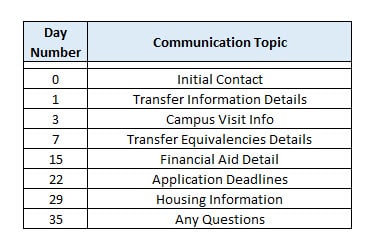
Use automation to deliver confirmations, reminders, and relevant resources, but define stop and change conditions. A prospect who applies, changes program, books an appointment, withdraws, or starts a direct conversation with admissions should not continue receiving an irrelevant generic sequence.
Measure the Full Follow-Up Journey
Do not evaluate inquiry management only through email opens, call counts, or the number of messages sent. Useful operational and enrollment measures include:
- Inquiry volume by source, program, market, and intake
- Percentage of inquiries assigned successfully
- Time to automatic acknowledgement
- Time to first meaningful response
- Percentage contacted within the institution’s standard
- Reply and appointment-booking rates
- Event registrations and attendance
- Application starts and completions
- Offers, deposits, and confirmed enrollments
- Conversion rate and cost per enrolled student by source
- Unanswered, overdue, duplicate, or incorrectly routed inquiries
- Reasons prospects do not progress
Review results jointly with marketing and admissions. A campaign may generate many inquiries but few eligible applicants. Another source may produce fewer inquiries that progress efficiently. Feedback from admissions should influence campaign targeting, forms, landing pages, qualification rules, and future content.
A Practical Student Inquiry Follow-Up Checklist
- Forms request only information needed for the next step.
- Every field has a visible label, clear instructions, and accessible error handling.
- Source, program, intake, language, and consent information enter the CRM correctly.
- Every inquiry receives an owner, due date, and backup route.
- Automated acknowledgements set accurate expectations.
- The first personal response addresses the specific inquiry.
- Channel and contact frequency reflect preference, permission, and context.
- Lead-scoring rules are documented, relevant, and reviewable.
- Automation changes when a prospect replies, applies, or enters direct support.
- Marketing and admissions review progression to application and enrollment.
Frequently Asked Questions
What is student inquiry follow-up?
Student inquiry follow-up is the process of acknowledging, assigning, answering, prioritizing, and nurturing a prospective student’s request for information. It connects marketing lead generation with admissions activity and should continue until the inquiry is resolved, transferred to another process, or closed appropriately.
How quickly should a school respond to a student inquiry?
Schools should define realistic response standards by channel, inquiry type, staff coverage, and operating hours. An automatic confirmation can be immediate, while the first meaningful response should occur within the institution’s published or internal standard. High-intent requests may require faster personal outreach and escalation rules.
What information should an inquiry form collect?
Collect only what is necessary to route and answer the inquiry, such as contact information, program interest, intended start period, relevant location, the prospect’s question, and communication preferences. More sensitive or detailed information can be requested later when it is genuinely required.
Should every inquiry receive a phone call?
No. The channel should reflect the prospect’s request, consent, communication preference, question complexity, time zone, and stage. Phone calls can be useful for complex or high-intent inquiries, while email, SMS, chat, or appointment booking may be more appropriate in other cases.
What should the first admissions follow-up include?
It should acknowledge the inquiry, reference the relevant program or question, provide one useful answer or resource, recommend one clear next action, and identify a person or team the prospect can contact.
How should schools score student inquiries?
Use transparent signals connected to program fit, timing, requested actions, application activity, events, and meaningful engagement. Avoid relying on protected personal characteristics or weak signals such as opens. Scores should trigger a defined service action and remain subject to human review.
Which metrics show whether inquiry follow-up is working?
Track assignment success, response time, replies, appointments, event participation, application starts and completions, deposits, confirmed enrollments, cost per outcome, and reasons inquiries fail to progress. Measure results by source, program, market, and intake.
Struggling with enrollment?
Our Inbound Marketing team can help you generate more leads!


