


For education marketing teams, Facebook and Instagram advertising can be valuable sources of prospective student inquiries. However, strong lead volumes and declining acquisition costs do not always translate into qualified applicants or increased enrollment.
A campaign may generate hundreds of inquiries while admissions teams struggle to contact the people behind them. Phone numbers are disconnected, email addresses are invalid, duplicate records accumulate, or individuals insist they never requested information.
These situations create an operational challenge. Marketing reports may suggest that campaigns are performing efficiently, while admissions staff spend valuable time following up on contacts who cannot progress through the recruitment process.
The immediate concern is often fake leads from Facebook ads, but not every unsuccessful inquiry is fraudulent.
Some submissions involve automated spam or deliberately incorrect details. Others come from genuine prospective students who submitted outdated information, misunderstood an advertisement, or are not ready to enroll.
Distinguishing between these situations is essential because the solutions differ. Improving Facebook lead ads quality requires schools to examine how inquiries are collected, where problems originate, and what happens after leads enter the admissions system.
This guide outlines a practical diagnostic process for identifying problematic inquiries, improving lead-capture methods, and measuring campaign performance against meaningful student recruitment outcomes.
Improve student inquiry quality.
Connect advertising data with admissions outcomes.

Are Your Facebook Leads Fake, Invalid, or Simply Unqualified?
Before changing advertising settings, schools should establish consistent definitions for problematic inquiries. Treating every unsuccessful contact as a fake lead can obscure the actual issue and lead to ineffective campaign adjustments.
A useful starting point is to separate leads into five categories.
| Lead Category | Common Indicators | Potential Cause | Recommended Response |
|---|---|---|---|
| Suspected spam | Repeated unusual submissions or identical answers | Automated or abusive form activity | Investigate form security and submission patterns |
| Invalid contact details | Disconnected numbers or undeliverable emails | Incorrect, outdated, or fabricated information | Review validation and verification options |
| Duplicate leads | Multiple records for the same individual | Repeat submissions or CRM integration issues | Review deduplication and source tracking |
| Low-fit inquiries | Prospect does not meet program requirements | Advertising or qualification mismatch | Refine messaging and relevant form questions |
| Unresponsive prospects | Valid details but no response after follow-up | Limited intent, timing, or communication issues | Assess contact attempts and nurturing processes |
These categories distinguish between data problems, potential fraud, and legitimate recruitment challenges.
For example, an applicant who submits the same form twice may create duplicate records without engaging in suspicious activity. Similarly, someone who does not answer an admissions call may still be considering the institution.
An inquiry should not be classified as fake simply because it does not produce an immediate response or application.
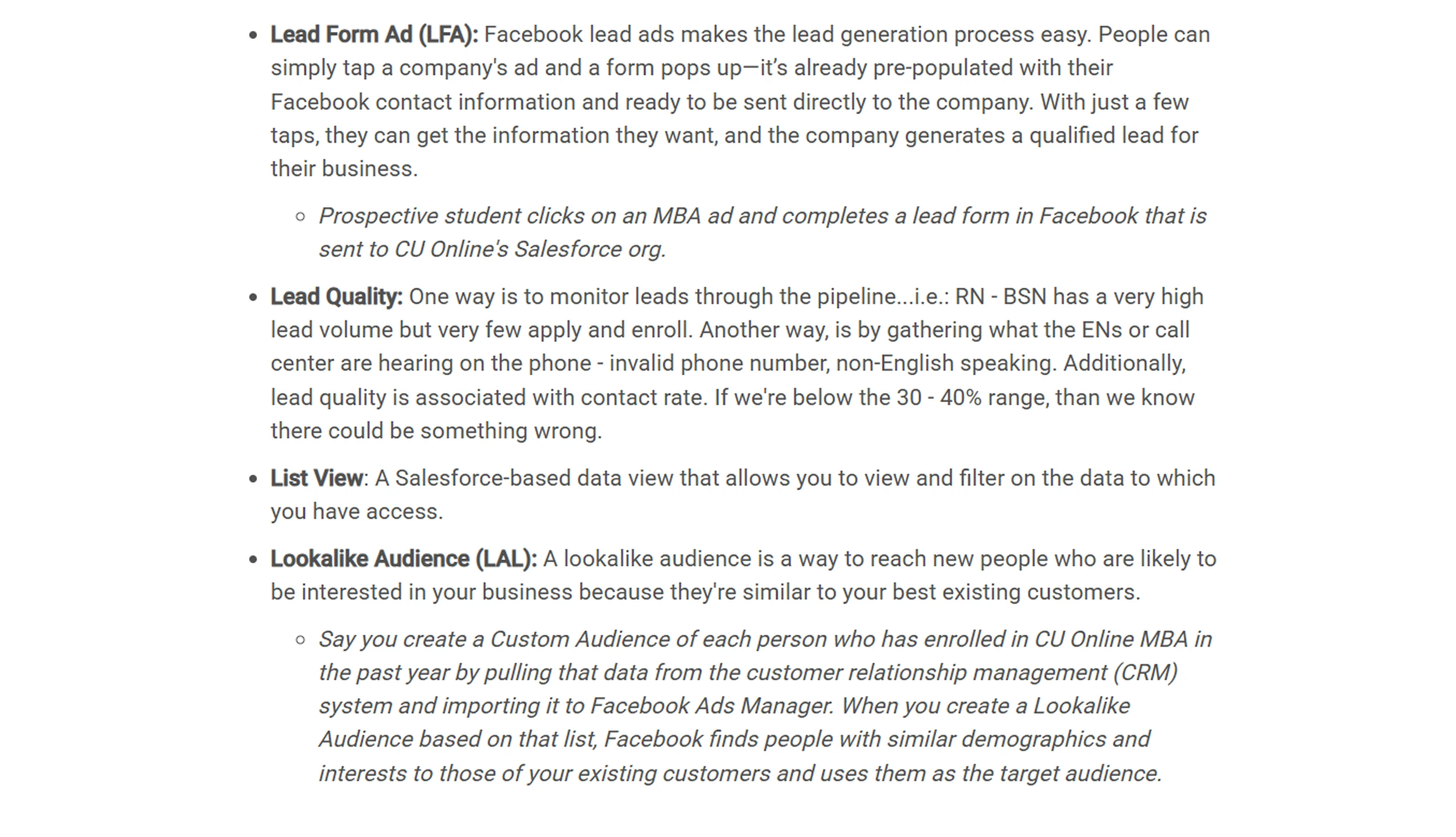
The University of Colorado makes this distinction in its CU Online marketing glossary. CU tracks invalid leads separately from broader lead quality and evaluates quality through contact rates, admissions feedback, and progression from inquiry to application and enrollment. This supports assessing unsuccessful contacts through several measures rather than assuming fraud.
Marketing and admissions teams should agree on these definitions before evaluating campaign performance.
Why Are Schools Getting Fake Leads From Facebook Ads?
The causes of poor lead quality can differ significantly depending on the advertising format, campaign messaging, and submission process.
1. Meta Instant Forms May Encourage Low-Intent Submissions
Meta Instant Forms allow people to submit their information within Facebook or Instagram rather than visiting an external website. Certain contact fields can be prefilled using information associated with the user’s Meta account, reducing the effort required to complete the form.
While convenient, this simplified experience can also produce inquiries from people who have not carefully considered the advertised program.
Consider the example of a career college promoting a business administration diploma. Someone browsing Instagram might open the advertisement out of curiosity and submit the form without reviewing the program requirements or tuition information.
The resulting inquiry is technically valid, but the prospect may have little intention of applying. Meta offers Instant Form configurations designed to support different objectives, including higher submission volume and greater intent. The appropriate option depends on the school’s recruitment priorities.
2. Advertising Messages May Create Incorrect Expectations
An advertisement can attract genuine prospects who misunderstand the offering. For example, a healthcare training advertisement emphasizing employment opportunities may attract people searching for immediate jobs rather than educational programs.
Similarly, advertising financial assistance without clarifying eligibility can generate inquiries from prospects who assume funding is guaranteed. These problems often indicate a messaging mismatch rather than fraudulent activity.
Schools should ensure advertisements clearly communicate relevant program details, including location, delivery format, qualifications, and important eligibility conditions. The goal is to attract prospective students who understand what the institution offers before submitting their information.
3. Contact Information May Be Incorrect or Outdated
Invalid contact details do not always indicate deliberate deception. A prospective student might enter a telephone number incorrectly, use an inactive email account, or submit prefilled information that is no longer current.
However, deliberately fabricated information and unauthorized submissions are also possible. Admissions teams should distinguish between technically invalid information and situations where a person explicitly denies submitting an inquiry. Both warrant investigation, but they do not necessarily have the same cause.
4. Website Forms May Receive Automated Spam
Not every suspicious inquiry attributed to Facebook originates from a Meta-hosted form. Schools using Meta campaigns to direct visitors to website landing pages should also assess their own form security. Automated scripts can submit website forms without using Meta Instant Forms.
When spam protection is inadequate, these submissions may enter the CRM alongside genuine advertising inquiries. Determining where the form was completed is therefore essential before identifying the likely cause.
How Can Schools Identify Where Poor-Quality Leads Originate?
A reliable lead-quality investigation should connect advertising records with CRM data and admissions feedback.
The objective is to determine whether problems are concentrated in particular campaigns, advertisements, forms, programs, or recruitment markets.
Step 1: Separate Meta Instant Forms From Website Forms
Meta-hosted and website-based forms operate in different technical environments.
| Meta Instant Forms | Website Inquiry Forms |
|---|---|
| Completed within Facebook or Instagram | Completed on the school’s website or landing page |
| Form controls depend on Meta’s available features | Validation and security can be configured through the website |
| May contain prefilled account information | Fields and submission behavior are managed by the institution |
| Lead records can contain Meta form and campaign identifiers | Records may contain UTMs, landing-page details, and technical submission data |
Schools using both approaches should compare their results separately. Otherwise, a website security problem could be incorrectly attributed to Meta’s lead-generation tools.
Step 2: Trace Leads to Individual Campaigns and Forms
Every inquiry should ideally retain its advertising source. Useful fields include campaign, ad set, advertisement, form or landing page, program interest, submission date, and recruitment market.
The University of Minnesota formalizes this process through its University Marketing Communications UTM tracking guidelines. Its marketing teams use standard source, medium and campaign parameters, including identifiers for Facebook and paid social, so campaign traffic and conversions can be traced consistently rather than grouped into ambiguous referral categories.
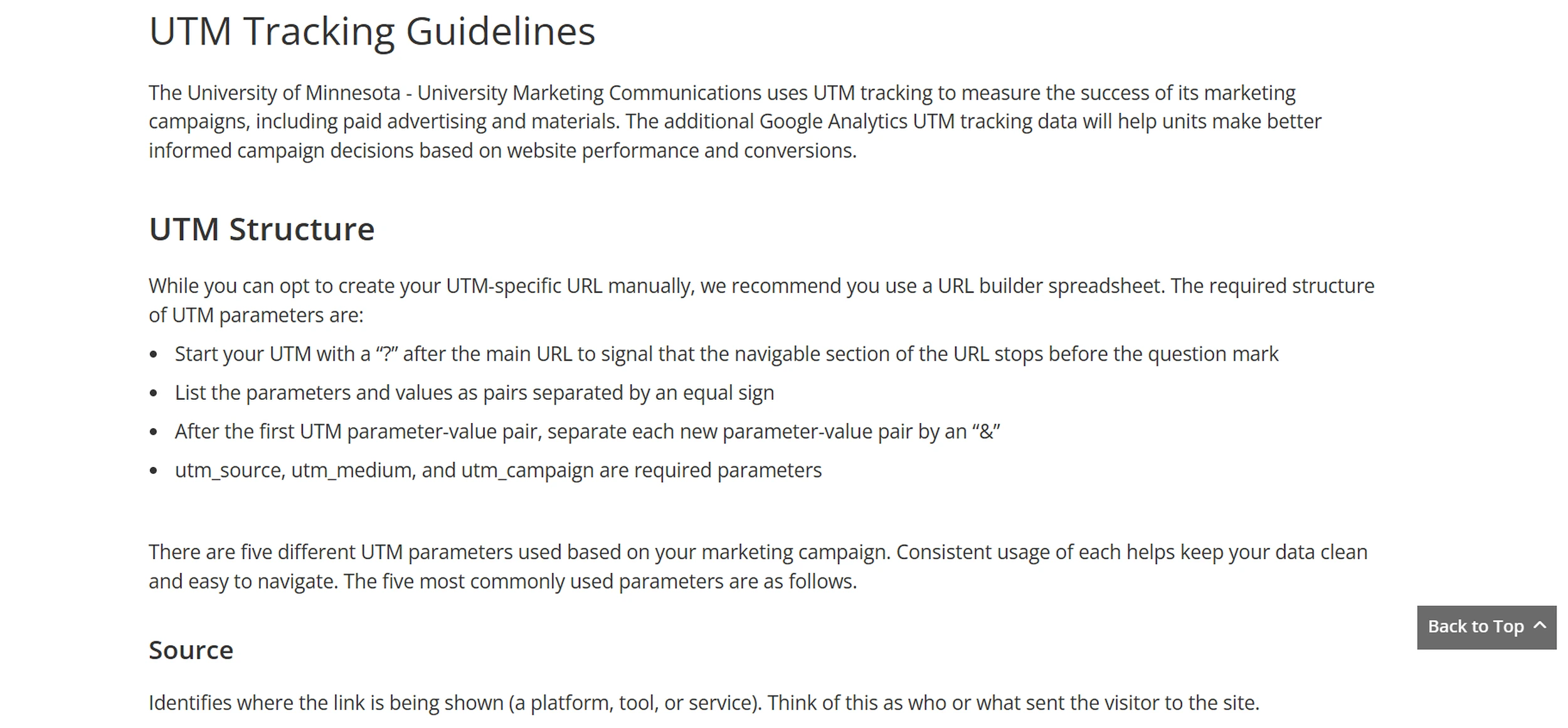
Where supported, Meta lead and form identifiers, along with appropriate UTM parameters, can help connect the original submission to its CRM record.
This makes it possible to identify patterns. For example, if invalid telephone numbers are concentrated in one form, the issue may involve its submission settings.
If low-fit inquiries appear across several advertisements promoting the same program, the problem may involve the campaign message or qualification requirements.
Step 3: Examine Admissions Outcomes
Advertising data reveals how many leads were generated and their acquisition cost. Admissions data reveals whether those inquiries were usable.
Teams should review whether prospects were successfully contacted, understood the advertised program, met relevant requirements, and progressed to applications. This provides a stronger basis for diagnosing lead quality than campaign-level CPL alone.
What Should a Facebook Lead-Quality Triage Sheet Include?
A simple lead-quality triage sheet can help marketing and admissions establish consistent classifications. The following example uses fictional records with non-identifying lead IDs.
| Lead ID | Source | Observed Issue | Admissions Finding | Classification |
|---|---|---|---|---|
| L-101 | Instant Form A | Disconnected number | Contact unavailable | Invalid |
| L-102 | Instant Form B | No response | Two calls and one email | Unresponsive |
| L-103 | Website Form C | Repeated unusual entries | Suspicious submission pattern | Suspected spam |
| L-104 | Instant Form A | Existing contact | Earlier inquiry located | Duplicate |
| L-105 | Instant Form B | Incorrect expectations | Seeking employment, not training | Low-fit |
| L-106 | Website Form C | Contact confirmed | Interested in next intake | Qualified |
Schools can use this approach to investigate a representative sample of recent submissions. The resulting classifications should eventually become part of CRM reporting rather than remaining in disconnected spreadsheets.
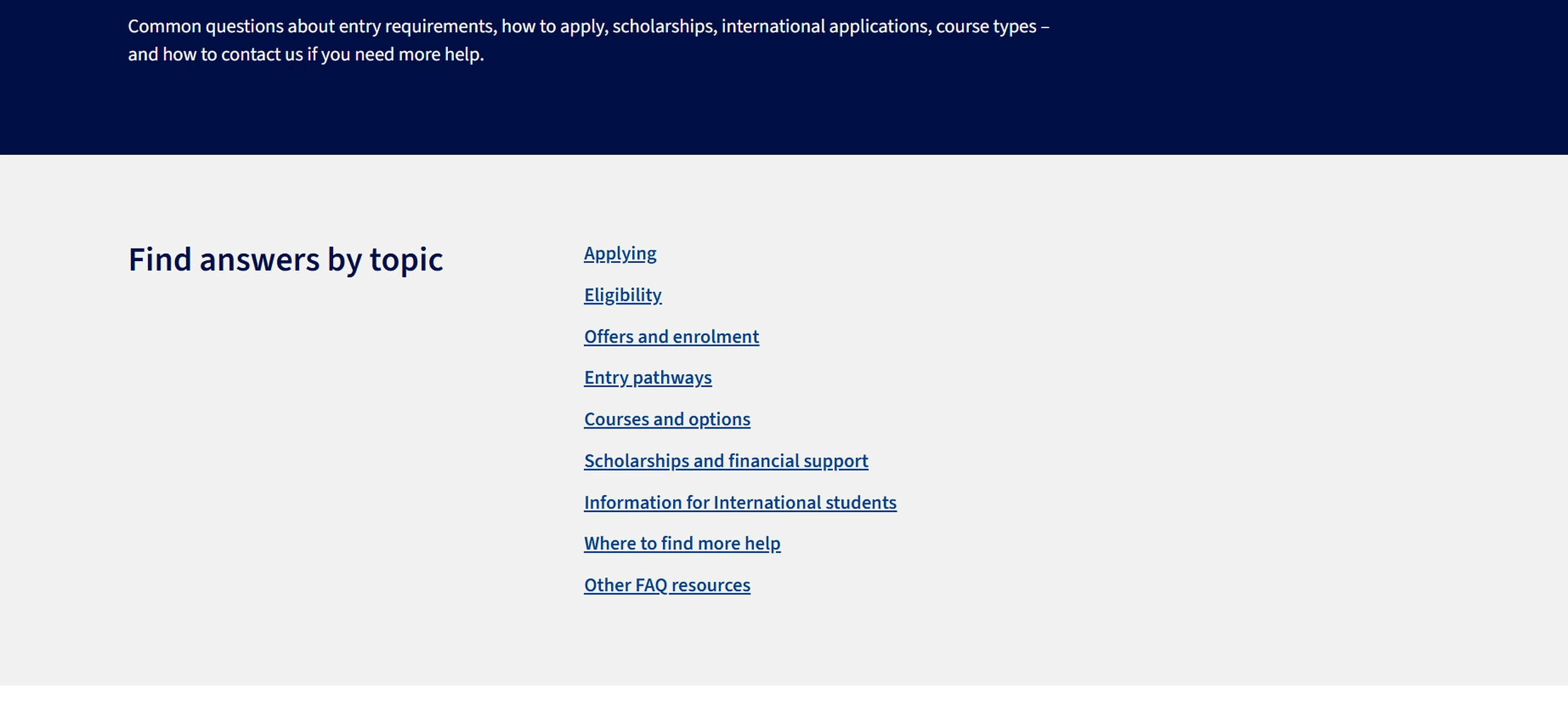
The University of Melbourne illustrates how organizing future-student questions by topic can help people find relevant information before contacting admissions. Its FAQ page groups guidance on applying, eligibility, offers and enrollment, courses, and financial support, and points readers toward further help. Schools can use these topics to structure inquiry questions and route follow-up, although the FAQ page itself does not document an internal lead-routing workflow.
How Should Teams Interpret the Results?
Suppose a particular website form generates repeated suspicious submissions, while a Meta Instant Form produces genuine contacts who misunderstand the program.
These findings require different responses. The website form may need stronger spam protection. The Instant Form campaign may need clearer advertising messages and additional qualification questions. The investigation should connect each observed problem to a plausible cause before changes are introduced.
How Can Schools Improve Meta Instant Form Lead Quality?
When problematic inquiries originate from Meta Instant Forms, schools can review the available form configuration and qualification options.
Test Higher Intent Forms
Meta’s Higher Intent form setting introduces an additional review and confirmation stage before submission. This gives prospects an opportunity to reconsider their information before completing the inquiry.
For schools experiencing accidental submissions, the extra step may help improve contact quality. However, it cannot establish that every submission represents a genuine prospective student.
The effectiveness of Higher Intent forms should be evaluated through contactability, qualification rates, and subsequent application activity. Meta’s Lead Ads documentation describes the review-and-confirm functionality.
Add Relevant Qualification Questions
Qualification questions help admissions understand what the prospective student wants and whether the program aligns with their circumstances. For example, a career college might ask:
Which program interests you?
- Healthcare Administration
- Medical Office Administration
- Business Administration
- Still exploring options
When would you like to begin studying?
- Within three months
- Within six months
- Next year
- Not yet decided
What information would you like?
- Admission requirements
- Tuition and payment options
- Program details
- Application assistance
These questions provide useful recruitment context without turning a simple inquiry into a lengthy application. Schools should avoid collecting unnecessary sensitive information or introducing questions that conflict with applicable advertising and privacy requirements.
Review Conditional Questions and Lead Filtering
Where supported by the account and form configuration, conditional questions can help guide applicants through relevant follow-up questions. Meta’s lead-form reference documents dependent conditional questions; confirm the options available in the school’s form builder before testing them.
For example, a school offering programs at multiple campuses could ask about preferred study location before presenting additional options.
Lead filtering should be used carefully. Someone unable to attend an upcoming intake might remain a valuable prospect for a later start date. The objective is to identify recruitment fit, not automatically exclude everyone who is still researching.
Consider Contact Verification
Where available, phone verification can provide additional assurance that a submitted telephone number is accessible. Meta’s lead-form reference includes an SMS verification setting, but schools should confirm availability in their own account.
However, availability and configuration may vary across Meta accounts and markets. Verification also introduces an important distinction: a verified contact number is not proof of educational interest or enrollment intent.
Schools should assess whether additional verification reduces invalid contacts without creating excessive barriers for legitimate applicants.
What Can Schools Do About Spam on Website Inquiry Forms?
Website forms require a separate technical assessment because the institution controls more of the submission environment.
Several safeguards can help reduce unwanted submissions:
- Spam detection: Services such as Google reCAPTCHA can assess suspicious interactions.
- Server-side validation: Submitted information should be checked by the server, not exclusively by browser-level controls.
- Rate limiting: Reasonable submission limits can help restrict repeated automated requests.
- Duplicate detection: CRM rules can identify repeated records without automatically discarding legitimate returning prospects.
- Submission monitoring: Reviewing technical patterns can help identify unusually frequent or suspicious activity.
These measures should be implemented with appropriate privacy safeguards. Anti-spam systems are not infallible. Google’s reCAPTCHA v3, for example, assigns risk scores that website operators use when determining appropriate actions.
The University of Oregon takes a layered approach to online-form abuse. Its security guidance recommends structured fields, validation, monitoring for repeated or unusual submissions, authentication where appropriate, and CAPTCHA as one safeguard, while cautioning that CAPTCHA alone cannot prove that a submission is genuine.
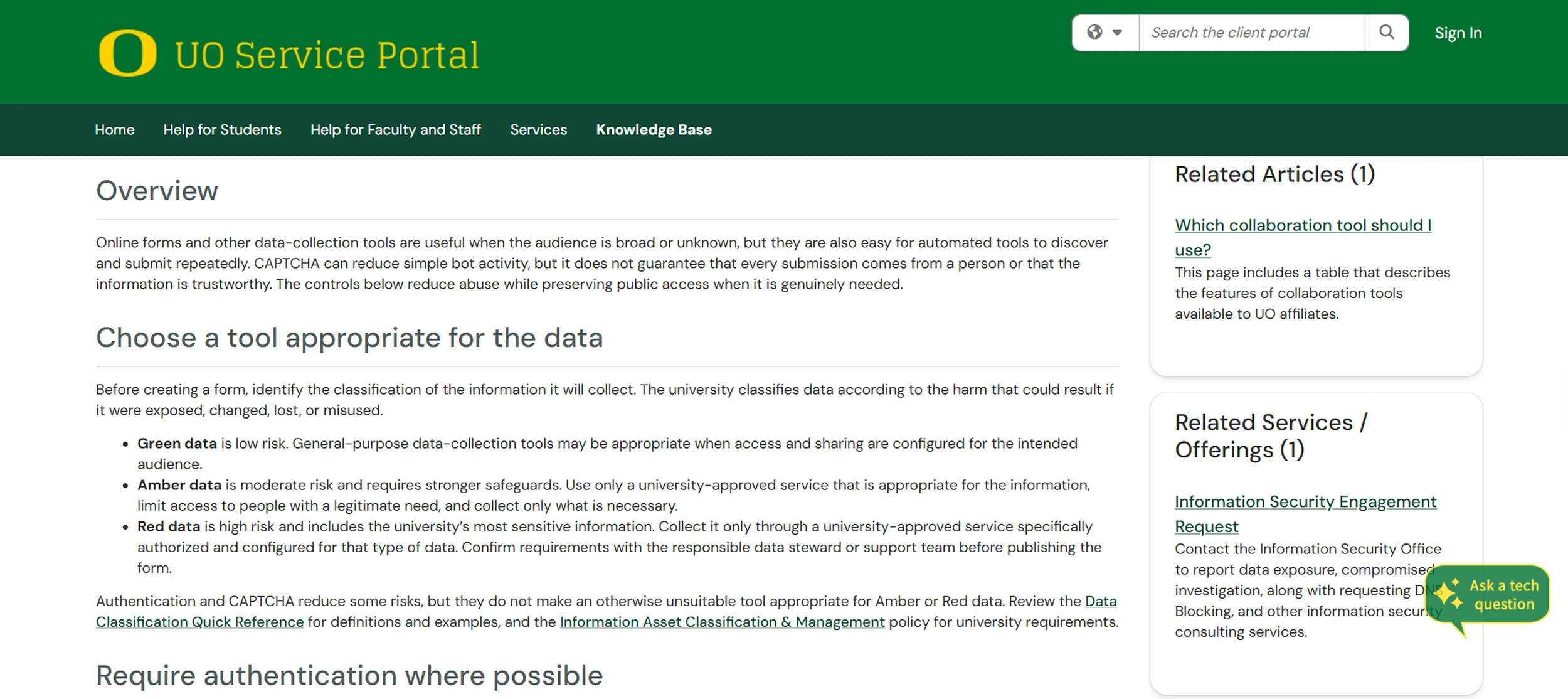
Schools should therefore monitor false positives and avoid unnecessarily blocking genuine prospective students.
Why Can Lower Cost per Lead Still Mean Worse Results?
A central challenge in education lead generation is that a campaign can look successful within Meta Ads Manager while producing limited admissions value.
Consider two hypothetical campaigns with identical budgets.
| Metric | Campaign A | Campaign B |
|---|---|---|
| Advertising spend | $3,000 | $3,000 |
| Total leads | 150 | 75 |
| Cost per lead | $20 | $40 |
| Usable inquiries | 45 | 60 |
| Cost per usable inquiry | $66.67 | $50 |
| Applications | 9 | 18 |
| Cost per application | $333.33 | $166.67 |
Campaign A generates twice as many leads at half the cost per lead. Based exclusively on CPL, it appears to perform better. However, only 30% of Campaign A’s submissions qualify as usable inquiries, compared with 80% for Campaign B.
Campaign B produces more usable contacts and twice as many applications from the same advertising investment. This difference matters when admissions staff must review and contact every lead.
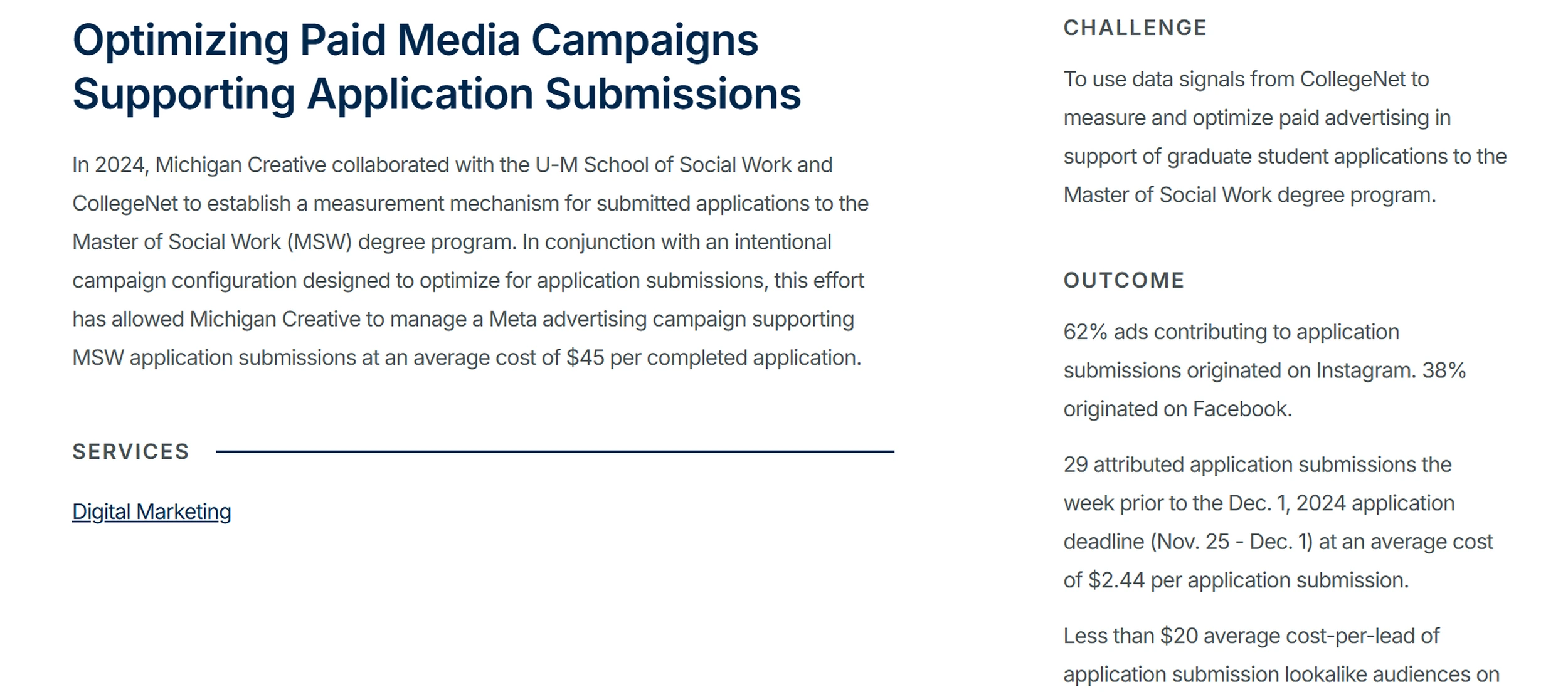
The University of Michigan School of Social Work provides a clear example of moving beyond CPL. Michigan Creative connected CollegeNet application-submission data with its Meta campaigns and optimized paid social against completed applications, reporting 159 application-submission conversion events at an average cost of approximately $45 per completed application. These are attributed conversion events reported in the case study, rather than a count of enrolled students.
Invalid and irrelevant inquiries consume resources without contributing meaningfully to student recruitment. Schools should evaluate acquisition costs alongside the proportion of inquiries that can realistically progress toward enrollment.
Which Metrics Show Whether Lead Quality Is Improving?
Lead-quality reporting should combine campaign costs with meaningful CRM and admissions outcomes.
| Metric | Purpose |
|---|---|
| Invalid contact rate | Measures submissions containing unusable contact details |
| Duplicate rate | Identifies repeated or existing records |
| Contactability rate | Measures prospects successfully reached |
| Qualified inquiry rate | Identifies prospects meeting agreed qualification criteria |
| Cost per usable inquiry | Measures acquisition cost after unusable records are excluded |
| Cost per qualified inquiry | Measures acquisition efficiency for relevant prospects |
| Inquiry-to-application rate | Tracks progression into the application process |
| Cost per application | Measures advertising spend relative to attributable applications |
Definitions should remain consistent across campaigns. For example, one campaign should not classify a lead as unresponsive after a single missed call while another receives several follow-up attempts.
Marketing and admissions should also agree on what qualifies as a usable or qualified inquiry. For a detailed explanation of connecting advertising activity to downstream recruitment outcomes, see HEM’s guide to offline conversion tracking for schools.
How Should Marketing and Admissions Work Together on Lead Quality?
Lead quality cannot be diagnosed effectively when marketing and admissions evaluate different measures of success.
Marketing may see increasing submissions and attractive CPL figures. Admissions may see unanswered calls, invalid contact information, and applicants who do not meet program requirements.
Both perspectives are necessary. A regular lead-quality review should address three areas.
What Has Changed?
Identify campaigns experiencing increases in invalid contacts, repeated submissions, or declining qualification rates. Compare these patterns with previous periods and similar campaigns.
What Does Admissions See?
Review representative lead records and documented contact outcomes. Are prospects receiving calls? Do they understand the advertised program? Are they eligible? Do they progress to applications? These questions help determine whether the problem involves acquisition, messaging, or follow-up.
What Should Marketing Test?
Select changes that correspond to the evidence. For example, a campaign attracting prospective employees rather than students may need clearer program messaging.
A form producing frequent accidental submissions may warrant testing Higher Intent settings. A website receiving repeated automated entries may need technical intervention. Where practical, test changes individually so their effects can be measured.
Schools should also allow sufficient time for admissions follow-up and application progression before drawing conclusions.
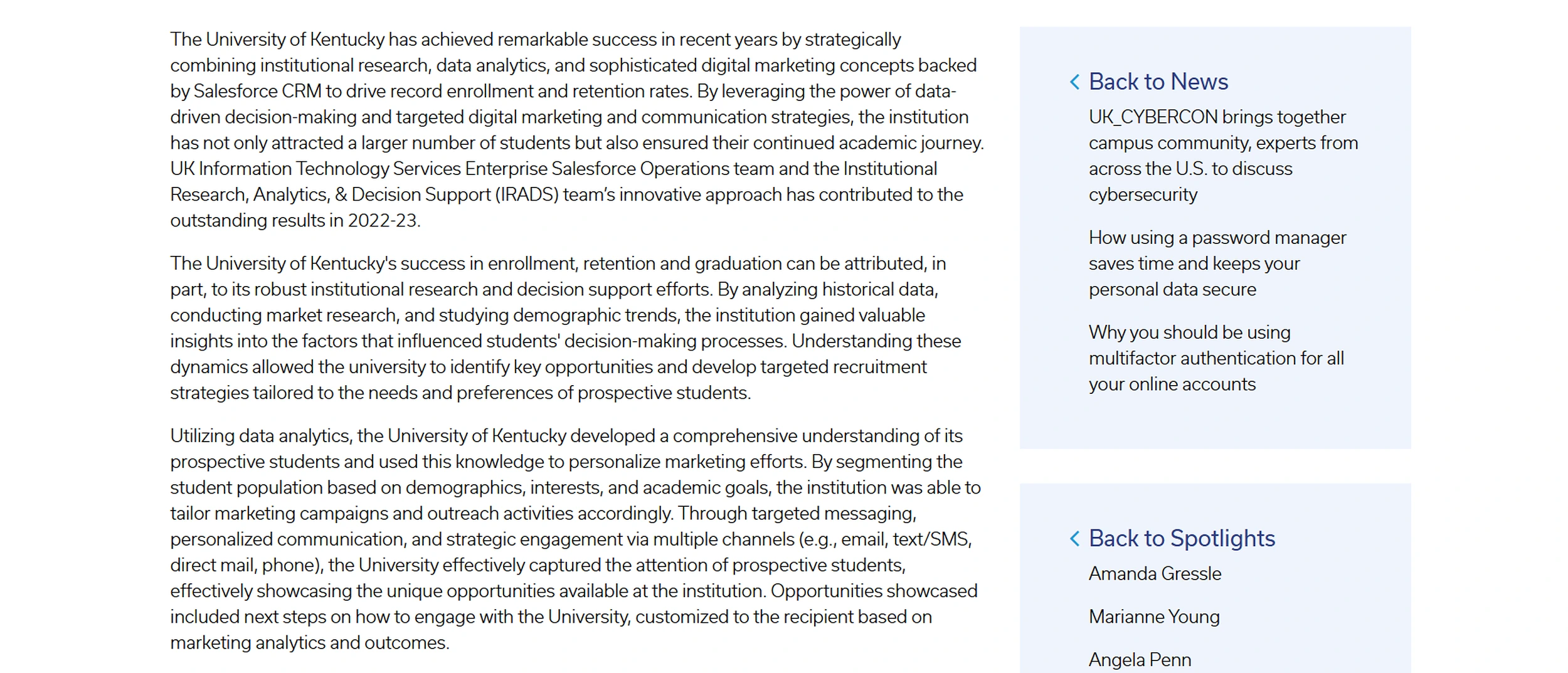
The University of Kentucky illustrates the value of connecting recruitment marketing with downstream student data. Its 2023 case study describes how teams used institutional analytics and Salesforce CRM to track prospective students from initial inquiry through enrollment, refine targeted communications, and coordinate recruitment insights rather than evaluating marketing activity in isolation.
A Practical Seven-Step Facebook Lead-Quality Audit
Schools experiencing a rise in problematic inquiries can use the following diagnostic process:
- Define lead-quality categories: Establish shared criteria for spam, invalid contacts, duplicates, low-fit inquiries, and unresponsive prospects.
- Collect a representative sample: Review recent submissions across campaigns, forms, programs, and recruitment markets.
- Confirm the submission source: Separate Meta Instant Forms from website landing pages.
- Connect records with admissions outcomes: Identify contactability, qualification, and application progression.
- Investigate recurring patterns: Determine whether problematic submissions are concentrated within particular sources or advertisements.
- Implement targeted improvements: Adjust messaging, qualification questions, form settings, technical safeguards, or follow-up processes.
- Measure the results: Compare lead-quality rates, acquisition costs, and admissions outcomes after the changes.
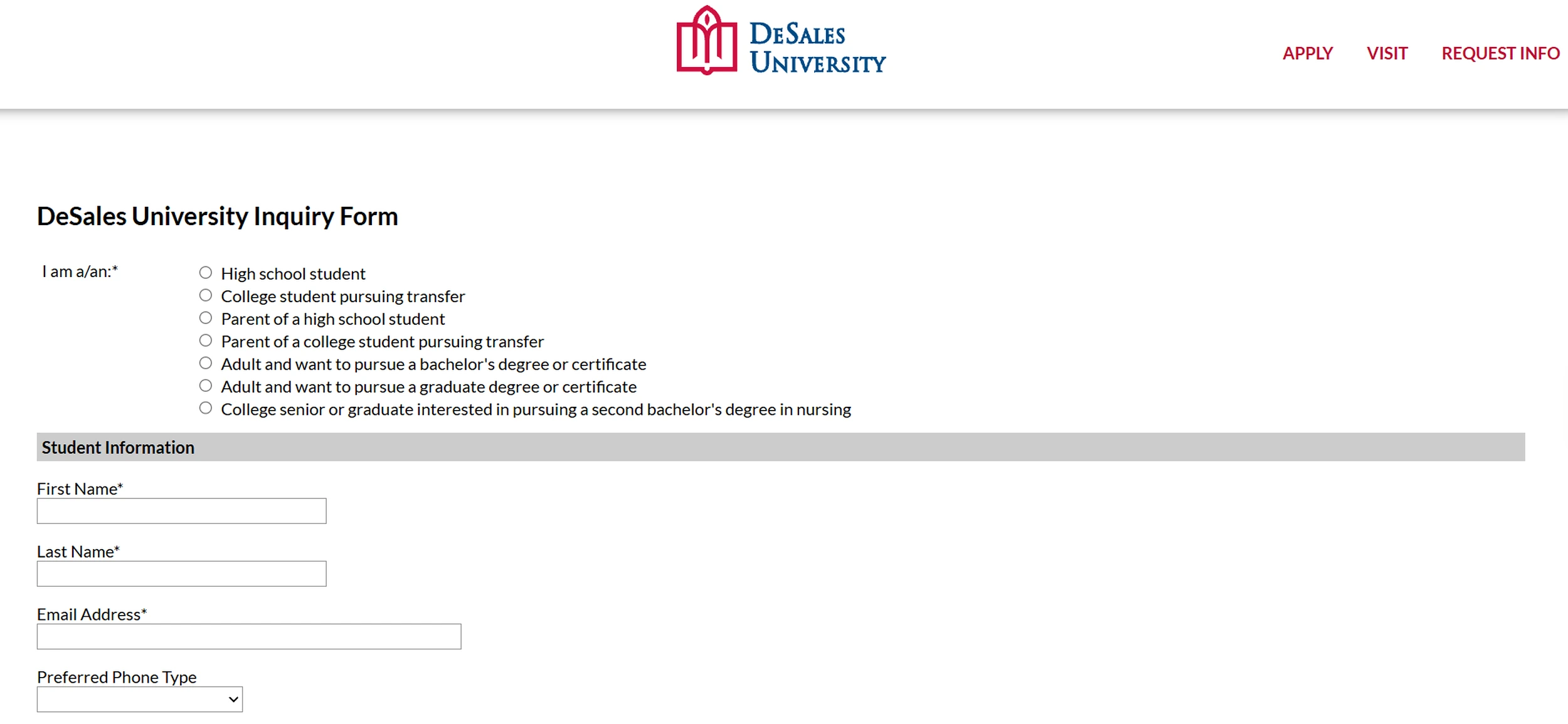
DeSales University provides a simple example of gathering qualification context at the point of inquiry. Its inquiry form asks prospects to identify their applicant type, specific program of interest, and anticipated entry term, giving admissions teams more useful context than a name, email address, and telephone number alone.
This approach helps schools improve Meta ads lead quality through evidence rather than assumptions. It also provides a clearer basis for deciding whether an underperforming campaign should be refined, paused, or allocated additional resources.
Final Thoughts: Diagnose the Problem Before Changing Your Facebook Campaigns
Receiving fake leads from Facebook ads can create considerable frustration for marketing and admissions teams, particularly when advertising reports suggest that campaigns are performing well.
However, different lead-quality problems require different responses. Automated spam calls for technical investigation. Invalid contact details may justify reviewing form validation. Poor program fit requires closer attention to campaign messaging and qualification questions.
Unresponsive prospects may need more effective admissions follow-up rather than additional submission restrictions. The priority is to establish what is happening before deciding what to change.
By classifying problematic inquiries, tracing their source, and comparing advertising results with admissions outcomes, schools can make better-informed campaign decisions.
For institutions investing in paid advertising for schools, success should be measured by more than the number of leads generated. The objective is to attract genuine, relevant, contactable prospective students who can progress toward applications and enrollment.
Are Invalid Inquiries Affecting Your Student Recruitment Results?
Request a free student recruitment assessment to discuss your institution’s lead-quality challenges and identify opportunities to improve campaign performance.
HEM can help you examine the evidence behind invalid contacts, low-fit inquiries, and weak application progression. Detailed account-level analysis requires access to the relevant advertising, form, and admissions data.
Improve student inquiry quality.
Connect advertising data with admissions outcomes.
FAQ
Why am I getting fake leads from Facebook ads?
Possible causes include automated spam, invalid contact information, accidental Instant Form submissions, duplicated CRM records, and misleading advertising expectations. Schools should first determine which type of problem is occurring and trace it to the relevant campaign or form.
Are unresponsive student inquiries always fake?
No. A genuine prospective student may be busy, researching several institutions, or no longer interested. Unresponsive leads should be assessed using a consistent follow-up process before being classified. Lack of response alone does not establish fraud.
How can schools distinguish spam from low-quality leads?
Spam typically involves suspicious or abusive submissions, while low-quality leads may come from real people who do not match the program or institution’s recruitment requirements. Review contact validity, submission patterns, program interest, and admissions feedback to distinguish the two.


